Educational use only — not medical advice. This is a teaching example and must not be used to guide care of any individual patient. Learn more →

False Trigger Confirmed by Esophageal Pressure Monitor

Using esophageal manometry to confirm a false trigger when circuit condensation mimics patient effort.
False triggerM1M5
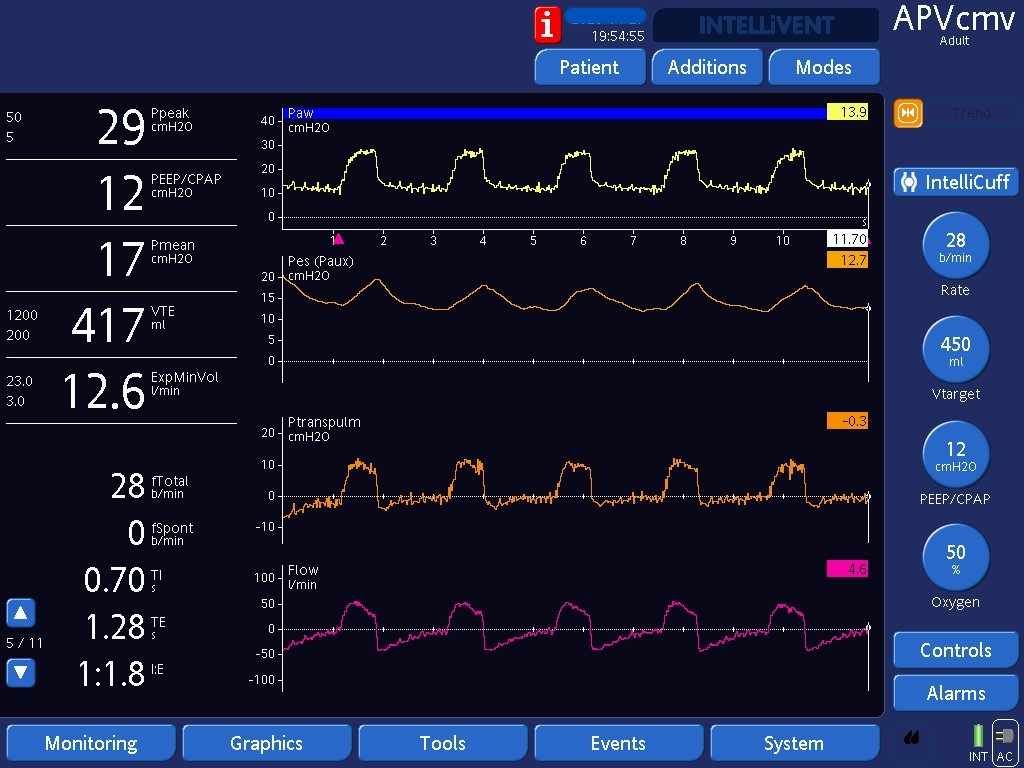
Fig 1.This waveform demonstrates a false trigger event (when a signal other than patient effort meets the trigger variable threshold). Note how pressure-time waveform for the first breath is marked with a purple triangle. This indicates that the condition for a patient-triggered breath was met (e.g., generation of a certain amount of positive expiratory flow). In other words, this is the ventilator saying that it thinks that the patient triggered that breath. This false trigger was caused by condensation in the circuit tubing that reverberates with gas flow. These reverberations are noted as small irregular oscillations on the pressure and flow waveforms. Although an esophageal balloon is not needed for this diagnosis, it elegantly confirms that this is indeed a false trigger event. Esophageal pressures, our surrogate for pleural pressures, drop in response to patient inspiratory effort, which does not happen at any point in this tracing.
Preview — work in progress