Educational use only — not medical advice. This is a teaching example and must not be used to guide care of any individual patient. Learn more →

Early cycle in VC

Identifying early cycling in volume control, where inspiratory effort extends past the set inspiratory time into expiration.
VCEarly cycleM2M5
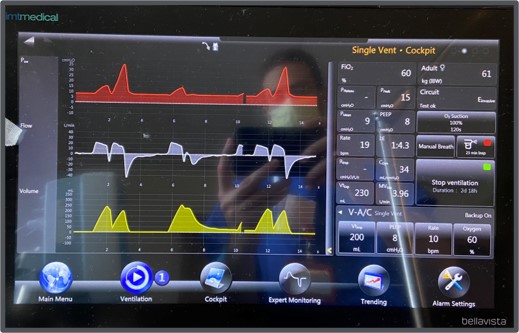
Fig 1.This patient was ventilated using a Bellavista ventilator, where breaths triggered by the patient are shaded (as seen with all breaths in this image). Start inspecting the third breath, in the middle of the screen. The mode here is VC with a partial descending ramp flow waveform. Since flow is the limit variable, we will look first at the inspiratory pressure-time graph. There is evidence of Pimus throughout inspiration: the patient triggers the breath (waveform is shaded) and the shape of the waveform shows negative deflections compared to what would be expected in passive patients (the pressure waveform in a partial descending ramp looks somewhere in between of what it would look in a full ramp and in a square flow waveform). Moving to the expiratory part of the flow waveforms still in the third breath, we see an early positive deflection that crosses baseline. This indicates that inspiratory effort extends through inspiration into expiration and almost triggers a second breath. The fact that the patient was active from the beginning of the breath all the way past the end of the cycle event indicates that inspiratory effort is longer than what we are setting for their inspiratory time. This characterizes early cycling. On the first and fourth breaths, double triggering happens because the inspiratory effort in early expiration is strong enough to meet the trigger threshold, leading to double triggering. Deepening sedation or increasing tidal volumes (note how small Vts are in this case) would be necessary to fix this abnormality in volume control. Decreasing flows to increase itime could also be attempted but would probably lead to flow starvation. Note how on the double triggered breaths airway pressures rise remarkably. This happens because we are effectively ventilating the patient with double the desired tidal volumes.
Preview — work in progress