ⓘEducational use only — not medical advice. This is a teaching example and must not be used to guide care of any individual patient.Learn more →
Stress Index
When to be careful about using the stress index — the impact of patient effort on waveforms.
VCMechanicsM4
⤢
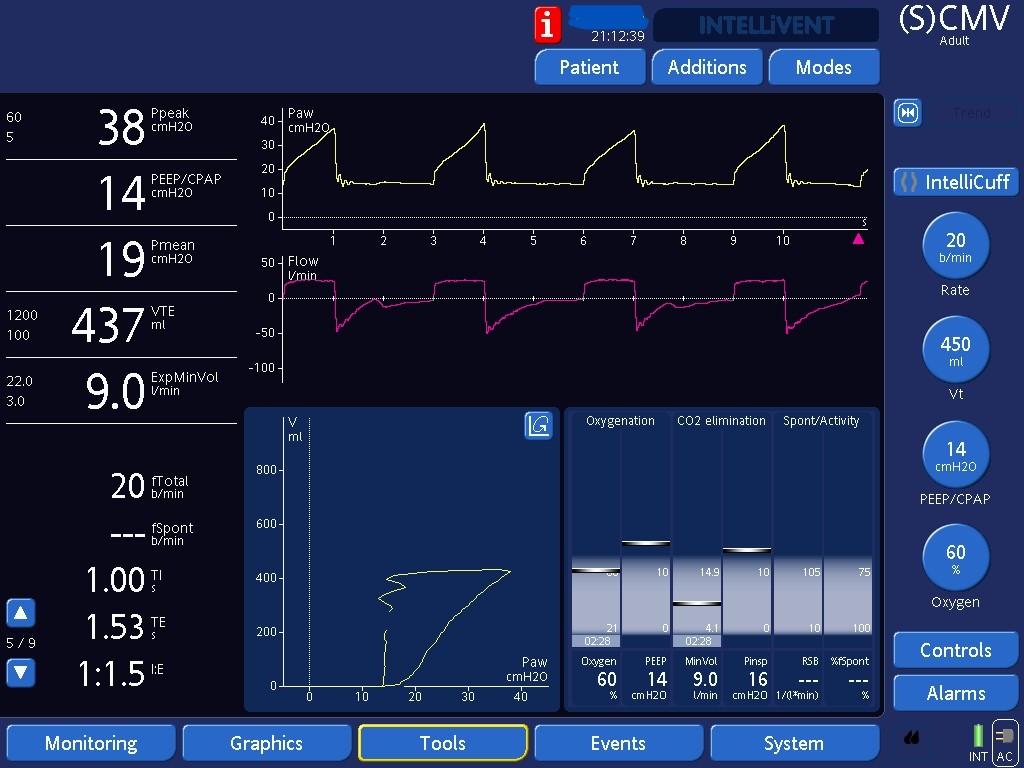
Fig 1.When using Volume Control with constant inspiratory flows we would typically be able to assess the stress index . The concept behind the stress index is that the analysis of the shape of the pressure-time curve may evidence changes in static compliance during inflation with tidal volume. Briefly, since flows are constant, you could think of the pressure-time curve as a pressure-volume curve. A rise in pressures with an upward concavity suggests that compliance worsens as lung inflates, which would be concerning for tidal overdistension. This would indicate that we are starting inspiration with too high lung volumes, suggesting that PEEP is excessive. A downward concavity suggests that compliance improves as lung inflates, which would raise the concern that we are starting off with too low lung volumes. An increase in PEEP would be the next step. A flat rise in pressures suggests that we are ventilating the lungs at their optimal, relatively constant compliance region, so PEEP would be considered appropriate. Breaths 2 and 4 show an upward concavity whereas breaths 1 and 3 show a flat rise. Why do we see this inconsistency? Likely the upward concavity seen here has nothing to do with changes of lung compliance during tidal volume delivery. Instead, it is simply the result of inspiratory effort (Pimus). Remember, Pimus will lower airway pressures. Mid-inspiratory Pimus will produce an upward concavity in Paw waveforms as seen in breaths 2 and 4. Another sign of inspiratory effort in this picture is the occurrence of positive deflections in expiratory flows in the expiration of breaths 1 and 3.